
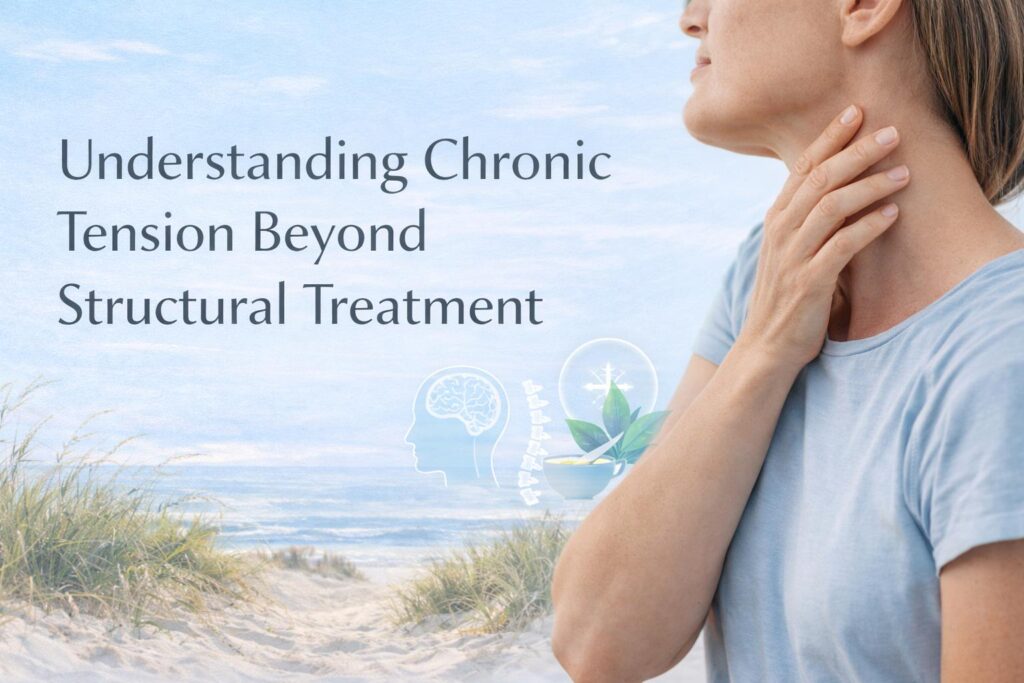
Many people seek help for ongoing neck, shoulder, jaw, and upper back tension.
They experience:
Persistent tightness
Teeth grinding and jaw clenching
A sensation of a “lump” in the throat
Frequent headaches
Upper body discomfort that never fully resolves
Often, they have already explored multiple treatment pathways, including physiotherapy, chiropractic care, osteopathy, sports physiology, massage therapy, and rehabilitation programs.
These modalities are evidence-based and essential in many cases. They help restore movement, strength, and structural balance.
However, when symptoms persist despite appropriate physical care and normal medical investigations, it may indicate that additional factors are contributing to the condition.
In these situations, a whole-person, integrative approach becomes important.
The Limits of Structural Treatment in Chronic Pain Conditions
Physiotherapy, chiropractic care, osteopathy, and sports physiology play a vital role in musculoskeletal health.
They address:
Joint mechanics
Muscle imbalances
Movement patterns
Postural strain
Load management
Rehabilitation after injury
For many people, this care resolves symptoms effectively.
However, chronic pain and tension do not always originate solely from structural dysfunction.
The human body is also shaped by: the nervous system, emotional regulation patterns, stress physiology, relational experiences, and trauma history.
When these systems remain dysregulated, physical symptoms may continue even after tissues have healed.
The Nervous System and Persistent Muscle Tension
Research in pain neuroscience has demonstrated that chronic pain is often influenced by nervous system sensitisation rather than ongoing tissue damage alone.
When the body has learned to remain in a state of heightened alertness, it may maintain excessive muscle tone and pain signalling.
This can lead to:
Chronic muscle guarding
Reduced tissue recovery
Increased pain sensitivity
Poor sleep quality
Fatigue and irritability
In trauma-informed and integrative health models, these patterns are understood as protective responses rather than pathology.
They represent the body’s attempt to maintain safety.
Emotional Suppression and Upper Body Pain Patterns
Many clients presenting with chronic jaw, neck, and shoulder tension report long-standing patterns of emotional suppression.
These patterns often develop in childhood or early adulthood when expressing feelings felt unsafe or unhelpful.
Common experiences include:
Learning to avoid conflict
Suppressing anger or sadness
Prioritising others’ needs
Minimising personal distress
Maintaining emotional self-control
Over time, these adaptations may become embedded physically. From both psychological and Chinese Medicine perspectives, unexpressed emotion is associated with stagnation in the upper body, particularly affecting the Liver, Heart, and Gallbladder meridian systems.
This can manifest as tension, headaches, and throat or jaw discomfort
Internal Family Systems (IFS), EMDR, And The Body
At Flow in Nature, integrative psychotherapy approaches such as Internal Family Systems (IFS) therapy and Eye Movement Desensitisation and Reprocessing (EMDR) are used alongside physical and nutritional care.
Internal Family Systems (IFS)
IFS recognises that individuals have multiple “parts” that develop to manage stress and emotional pain.
Some parts become responsible, critical, compliant, or hypervigilant. When these parts remain overburdened, their efforts are often expressed somatically.
For example, jaw tension may reflect suppressed anger, neck tension may reflect vigilance, and shoulder pain may reflect responsibility overload.
IFS therapy supports clients in building compassionate relationships with these parts, reducing the need for physical tension.
EMDR Therapy
EMDR is an evidence-based trauma therapy that supports the nervous system in reprocessing unresolved experiences.
By engaging bilateral stimulation, EMDR helps reduce physiological arousal linked to past stress and trauma.
This often leads to:
Reduced muscle tension, improved sleep, decreased pain sensitivity, enhanced emotional regulation.
When combined with body-based awareness, EMDR can significantly improve chronic tension patterns.
How to Begin Listening to Your Body at Home
Clients are often encouraged to develop gentle self-awareness practices.
A simple method includes: sitting quietly and breathing slowly. Placing a hand on the tense area and asking internally, “What are you holding?”
Noticing sensations, emotions, or images.
Responding with compassion rather than judgement.
This practice supports nervous system safety and internal communication.
Over time, it helps reduce unconscious muscle guarding
Lifestyle Strategies for Supporting Nervous System Regulation
Sustainable recovery requires consistent lifestyle foundations.
Prioritise Rest and Sleep
Poor sleep maintains pain sensitivity and emotional dysregulation. Aim for regular sleep-wake cycles and evening wind-down routines.
Gentle Movement and Walking
Walking supports bilateral integration and emotional processing. Regular low-intensity movement improves circulation and reduces stagnation.
Nutritional and Digestive Support
In Chinese Medicine, digestive strength supports emotional resilience. Warm, regular meals and appropriate nutritional supplementation support recovery.
Reduce Overstimulation
Chronic tension is often linked to excessive cognitive and emotional load.
Digital boundaries, nature exposure, and scheduled rest are essential.
When Medical Tests Are Normal, but Symptoms Persist
Many people with chronic tension are told, “Your scans are clear, “There is no structural problem.” “Everything looks normal.”
While reassuring medically, this does not mean the symptoms are psychological or imagined.
It means functional, neurological, and emotional contributors may be present.
These factors are not visible on imaging but have profound physiological effects.
Why Integrated Care Is Essential for Chronic Conditions
At Flow in Nature, chronic tension is approached through an integrative framework that combines: physical rehabilitation, manual therapies, nutritional medicine, Chinese Medicine, IFS-informed psychotherapy, EMDR therapy, Nervous system regulation and Lifestyle coaching.
This approach recognises that healing occurs across multiple systems simultaneously.
No single modality addresses every layer. Chronic tension is not a personal failure.
It reflects the body’s attempt to cope with complex life experiences.
Working With Flow in Nature
If you are experiencing ongoing neck, jaw, or shoulder tension that has not responded fully to conventional treatment, integrative care may be beneficial.
At Flow in Nature, treatment plans are personalized to address physical, emotional, and neurological contributors to health.
To learn more or book a consultation, visit flowinnature.com.au or contact the clinic directly.
Isabel Peace